





Thorstein (37) has never regretted choosing vocational subjects – today he has a doctorate
When Thorstein applied for vocational courses, the school counsellor wrinkled his nose. Now he works as an engineer.
When Thorstein Ravneberg Rykkje (37) was about to apply for upper secondary school, he was torn between specialising in general studies or vocational studies. For him, the choice was easy, he says, who today has a doctorate from Western Norway University of Applied Sciences (HVL).
"I haven't regretted it for a second," he states about his decision to study vocational studies.
After a career fair, Rykkje had the opportunity to see how an excavator worked, and then he was sold. He wanted to learn more about how large construction machines work.
"Super hard year at school"
After taking a certificate in construction machinery repairer in 2008, he worked both in a workshop for construction machinery and as an engineer on a submarine in the Armed Forces. After a few years, Rykkje felt that he had picked up most of what there was to learn about the machines.
"Then it was either further education or looking for a new job, and I focused on education. It was engineering that seemed most natural to me. I researched the different directions, and what seemed to build on what I already knew about hydraulics and mechanics was mechanical engineering," he says.
Before Rykkje could start his bachelor's degree in engineering, he had to go through a year of pre-courses.
"It was a super hard year at school with maths, physics, Norwegian and English, and some social studies on the side. But we were a good group who worked hard and got through it.
Valuable support from NITO
Rykkje says that during his time as a bachelor's student, the academic support NITO offered through the crash courses was important.
"It was absolutely king. It was former students who held courses for us in the most difficult math subject for engineers at the college. The instructor came in and did a brilliant job. In four hours, he got me at least two grades," he says, adding that other member benefits such as home contents insurance also came in handy.
The 37-year-old believes that words are not enough when it comes to determining the value of a trade certificate. He emphasizes that it is important to get rid of the old notion that attending vocational education is for the unmotivated.
"For those who are in secondary school and are going to apply further, I think it's a 'no-brainer' to go vocational first. Get a job, gain experience, and then you can go to university. Then you have a job at the bottom, and you can finance an apartment while you study," says Rykkje, who was himself a temporary worker and worked one day a week as a mechanic alongside his studies.
Unique expertise
The bachelor's thesis was ready in 2016, and Rykkje decided to continue his studies. At that time, he chose applied mathematics at the University of Bergen (UiB), because he wanted a deeper understanding of mathematics and numerical solutions. Rykkje brought with him expertise from both engineering and his trade certificate, which came in handy when he was writing his master's thesis.
"It was one of the rare times that a student in that master's programme submitted a physical object they had built and run calculations on. I built a steel pendulum and ran a numerical analysis on its movement. They are not used to that at UiB, that students can weld," he chuckles.
At the end of his master's studies, Rykkje's old professor and bachelor's supervisor, from HVL, picked up the thread.
"He asked if I was interested in a PhD," says the 37-year-old.
The two had collaborated on writing both Rykkje's bachelor's and master's thesis. He then started working as a PhD candidate at the PhD programme Computer Science.
Became a NITO union representative
During his doctoral studies, the 37-year-old became a union representative for NITO at the institution. During the period, he was involved in three salary negotiations, among other things.
"NITO members are scattered around different departments and departments. Inviting people physically to different events means that we have achieved a little more interdisciplinary discussion and insight into how the different departments have solved different problems.
"It has created a very good cohesion in the group," he points out, adding that he has received good professional support as a union representative from NITO.
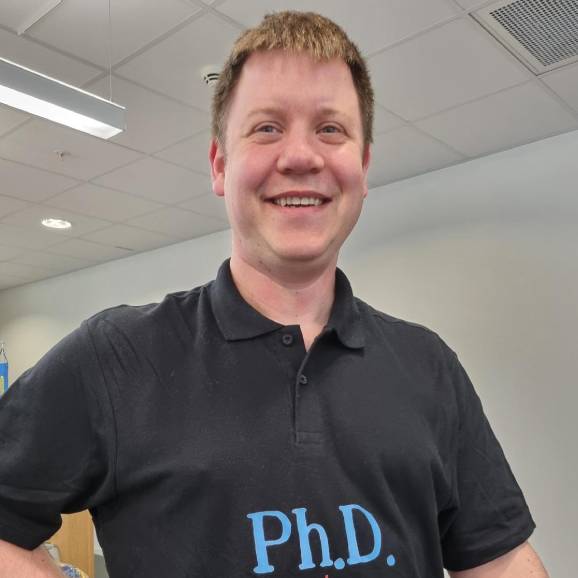
"Delivers a high level"
Today, Rykkje works as an engineer at Palfinger Marine Norway in Bergen. The company works with offshore cranes, and his role involves a collaborative position with the college. He conducts research and development using student projects at bachelor's and master's level.
He praises the students' efforts:
"It's a bit brutal, and they get the knife at their throat because we need what they do. There will be more motivation, but also more pressure, but they are very motivated, and they deliver at a high level," says the 37-year-old.
Rykkje's next goal is to gain more work experience as an engineer, and he is excited about the next four to five years.
"The next big 'hole' I see in my CV is that I haven't worked as an engineer in the industry for long. Now I have worked for a year, and there are exciting projects in Palfinger. I enjoy my position, where I can work closely with the students from the college," he says.