



The economy in the state settlement – this is how the numbers are connected
NITO's wage settlement in the state has been completed. But how can 2.7 percent for local negotiations be the same as the frontline trade's 4.4? Here we explain how.
When we say that the settlement in the state is on a par with the frontline trade, it is about how we calculate. The frontline trade, which is the settlement in internationally exposed industries, traditionally sets the norm for wage growth in Norway. This year, the frontline sector is estimated at 4.4 per cent. This is the same figure as the total limit in the wage settlement in the central government.
So how does 4.4 percent become 2.7 percent in the pot for local negotiations? Let's look at the math and explain the concepts behind it.
The math
| 4,4 % | Total limit Includes all wage growth during 2026, both in and outside the annual negotiations. The same financial framework as the frontline trade. |
| – 1.7% | Overhang from 2025 Last year's supplement was given from 1 May. Thus, the salary is already higher than last year, and we cannot count the same kroner twice. Subtracted from total frame. |
| – 0.8% | Slippage 2026 Wage growth that takes place outside of negotiations, for example when someone leaves and new ones start with higher wages. It must be subtracted before we distribute the rest of the pot. |
| – 0.1% | Changes to the common provisions Improvements to the basic collective agreement's common provisions cost money. These costs are deducted from the total framework. |
| = 1.8% | Available framework as of 1 January What is actually left for distribution. But: The supplements are given from 1 May, not 1 January. |
The figures are averages for all government employees. They say something about the total wage cost in the state, not what you will personally get. Some get more, some get less.
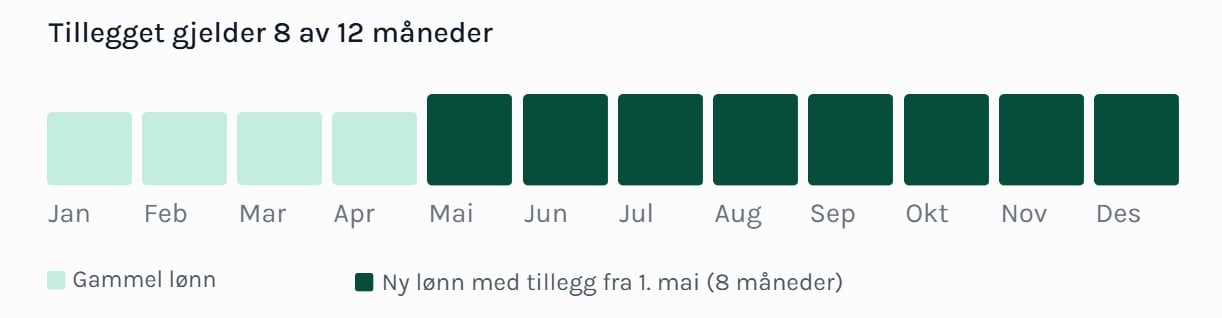
Since the pay increases are given from May, not January, the supplements only apply for eight months. Therefore, the framework must be recalculated:
1.8 percent x 12 months / 8 months = 2.7 percent
It is the pot that will be distributed in this year's local negotiations.
The terms and numbers explained – step by step
Do you want to understand more about what lies behind the numbers and concepts? Here we take a more thorough approach.
What is total frame?
This is the very starting point for the settlement. The figure is an estimate of how much the average salaries of all employees in the state will increase during the whole of 2026. In other words, it is not an expression of how much each individual employee should receive, but the average.
This year, the limit is estimated at 4.4 per cent. This is the same number as the frontline industry (exposed industry) ended up at.
The total limit includes the cost of all wage increases during the year – both what is given in this year's local negotiations and wage increases that take place outside, for example when someone changes jobs or increases their salary in special negotiations.
What is overhang?
We received the pay increase last year from 1 May, not 1 January. This means that your salary was higher in December than the average for the whole of last year. We call this difference overhang.
We will carry the overhang with us into the new year. Since your salary is already higher at the start of 2026 due to last year's settlement, this "eats" into this year's total frame. We can't spend the same money twice. Therefore, we subtract the overhang from the total framework before we calculate how much is left for local distribution. This year, the overhang is estimated at 1.7 per cent.
What is slippage?
The wage level in the central government is also increasing outside the fixed, annual local negotiations. This is what we call slippage. This happens, for example, when:
- Some quit and new employees start with a higher salary
- Special negotiations are being conducted to retain key expertise
- Employees receive higher salaries due to new work tasks.
Since the total framework will cover all wage increases during the year, we must set aside money for this slippage. Therefore, the slippage is also subtracted from the total frame before we can distribute the rest. This year, the slippage is estimated at 0.8 per cent.
What are the costs of the joint provisions?
The joint provisions are the part of the Basic Collective Agreement that regulates rights such as working hours, overtime pay, supplements for night and weekend work and leave of absence in the event of illness, childbirth and care.
In the main settlement, the parties negotiate the entire collective agreement and can agree to amend these provisions. This year, the supplements for evening, weekend and night work have increased.
Changes to the common provisions are not free of charge, but increase wage costs for the state. Therefore, the cost is deducted from the total wage framework, in the same way as overhang and slippage – before the rest is distributed in the local negotiations.
In this year's settlement, the parties agreed that adjustments to the joint provisions correspond to 0.1 per cent of the wage base.
What is disposable frame?
When we have deducted the overhang (money we have already secured), the slippage (money that goes to wage increases outside the negotiations) and costs for improving the common provisions, we are left with 1.8 percent. This is the available framework as of 1 January.
This is the fresh money that could actually be distributed – if the supplements had been given from 1 January and lasted for twelve months. But the supplements are not given from 1 January, they are given from 1 May.
What is local pot?
When the wage increases in the state are given from 1 May, it means that this year's increase only applies to eight months (May to December), not twelve.
Since the money will be distributed over fewer months, the percentage will be higher. When we recalculate the framework from twelve to eight months, the figure grows from 1.8 to 2.7 per cent:
1.8 percent × 12 months / 8 months = 2.7 percent
This is why 4.4 per cent in the total framework becomes 2.7 per cent in the pot for this year's local negotiations. The money does not disappear – we get it via mechanisms other than local negotiations.
And remember: These figures are the average for all government employees, not what you will personally receive. Some will get more, some less.