

Why do we map workflow in pathology?
To meet the needs of the future, we need more knowledge about how work processes work in practice.
Diagnostics are becoming increasingly complex. It is not only about more samples, but also about more comprehensive analyses, more personalized treatment and higher requirements for documentation, quality and traceability.
In the project, workflow is understood as the interaction between organisation, staffing, technology, information flow, physical logistics, standardisation, prioritisation and transitions between work steps. So it's not just about speed, but about how samples move through the system with the least amount of unnecessary waiting, interruptions, rework and accumulation.
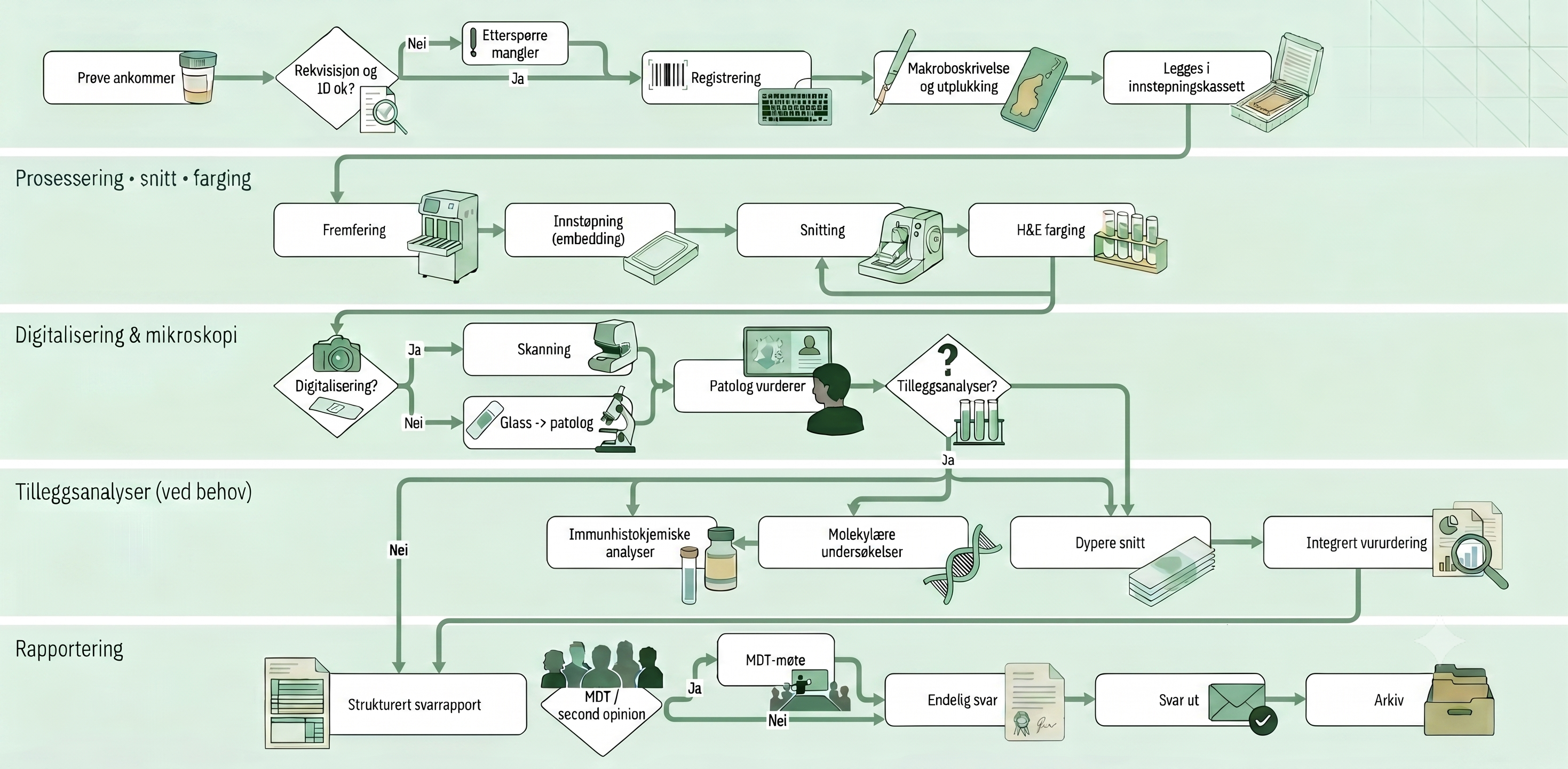
The mapping will help to highlight where the sample is actually processed, where it is waiting, and what conditions affect the overall lead time.
The goal is not for professionals to run faster, but to find time thieves, duplication of work and manual tasks that the system can solve better.
Small improvements can have a big impact
In laboratory work, many tasks are repeated thousands of times. Therefore, small improvements can have a big impact.
For example, if electronic requisition saves 2 minutes per requisition, for 10,000 requisitions it would be equivalent to: 20,000 minutes = 333 working hours = 44 working days
This is a simplified example, but shows why it is important to map workflows, system support and manual processes.
The questionnaires are built around defined work steps, so that experiences and practices can be compared across laboratories and processes.